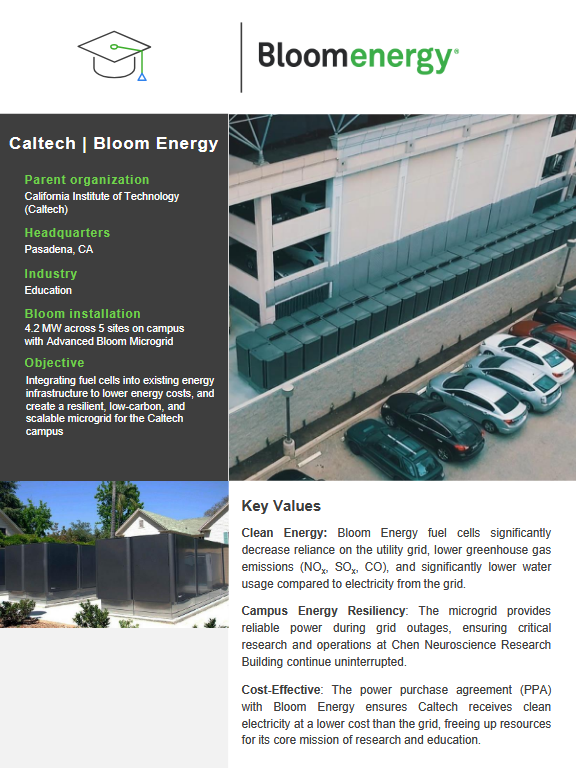
Beginning in 2009, Caltech installed a 1 MW fuel cell capacity to buy clean and economical power through a PPA agreement. The motivation was to meet increased load demand, sustainability goals, and reduce utility costs. The fuel cell operated 24/7 in parallel with the grid, helping offset expensive electricity costs. In 2015, Caltech added more fuel cells to power its campus as part of the PPA, further reducing energy costs.
In 2021, the addition of the Chen Neuroscience Research Building required additional power on campus. Due to the research’s sensitivity to power quality, always-on, reliable power was an important consideration. Caltech chose the Advanced Bloom Microgrid to supply 1.2 MW of uninterruptible, dedicated, load-following power for this application.
The microgrid solution operates simultaneously, with two sets of dedicated inverters: one load-following the microgrid and another operating in parallel with the utility grid. Bloom Energy uses custom microgrid controls that allow the microgrid inverter to load-follow Caltech’s Chen Neuroscience Research Building. Any additional power generated is exported to the rest of the campus via the MV substation.
Download the case study to learn more.