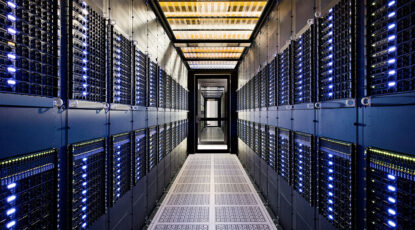
AI data center power consumption is rising rapidly as operators deploy more capacity and pack more computing power into each facility. In the United States, industry forecasts cited by Bloom Energy now put 2030 data center electricity demand between roughly 700 and 1,200 TWh.
Globally, the International Energy Agency projects data center electricity consumption to nearly double between 2025 and 2030.
Key Takeaways:
- Bloom Energy’s Mid-Year Pulse compiles industry forecasts showing U.S. data center electricity demand more than doubling by 2030
- AI racks that currently run at 150 kW will increase to 300 kW and eventually approach 1 MW
- Inference has surpassed more than half of AI computing power
- Utilities expect power to arrive 1.5–2 years later than developers plan for, per Bloom Energy’s 2026 Data Center Power Report
- When the grid is a bottleneck, Bloom Energy found 61% of developers would deploy onsite power as their primary strategy; only 12% would relocate
How Much Power Does a Data Center Use?
Bloom Energy’s Data Center Power Report Mid-Year Pulse cites three major forecasts projecting that U.S. data center electricity demand will range roughly from 700 to 1,200 TWh. In addition, the Electric Power Research Institute (EPRI) projects that by 2030, data centers could consume 9% to 17% of all U.S. electricity, up from about 4% to 5% today. Its updated 2030 projections are approximately 60% higher than the scenarios it published in 2024.
Grid operators are also revising their forecasts. ERCOT raised its 2030 estimates of data center growth from 29 GW to 77 GW, while PJM increased its 2030 peak-demand projection by approximately 10%.
How Much Power Does AI Need?
AI workloads, particularly those for training large models, are pushing power needs even higher. Rack densities that were measured in tens of kilowatts only a few years ago are now reaching roughly 150 kW for AI systems, with upcoming platforms expected to reach about 300 kW per rack, and future designs approaching 1 MW. That concentration of computing power means a comparatively small physical footprint can impose an enormous electrical and cooling load.
The demand for AI is increasingly coming from everyday use (also known as inference), not just training new models. Bloom Energy’s 2026 Data Center Power Report Mid-Year Pulse found that inference now represents more than 50% of total AI compute. Earlier forecasts had expected inference to reach that threshold around 2030. As AI moves into widespread deployment, inference is a sustained source of demand even as training workloads continue to grow.
AI workloads can also create more volatile power demand than traditional cloud computing. Large training jobs may run at very high power for extended periods, while synchronized computing activity can produce rapid swings in load. These changes put stress on power-delivery infrastructure and make stable, responsive power increasingly important.
Gigawatt-Scale Campuses Are the New Planning Unit
The growth is happening not only in the number of data centers, but in their size. About one in five new data center campuses is expected to exceed 1 GW by 2030, rising to nearly one in three by 2035.
A single 1 GW campus would consume electricity equivalent to roughly 20% of New York City’s total load.
Why AI Workloads Change the Power Equation
AI changes the power equation in two ways: data centers need much more electricity, and that electricity must support denser, more dynamic loads. Those two things limit where and how quickly new AI capacity can be built.
Bloom Energy’s 2026 Data Center Power Report Mid-Year Pulse found that 51% of respondents listed power availability among their top three site selection factors, ahead of fiber access, land availability, and local regulations. These constraints are reshaping the geography of data center development; by 2028, Texas is projected to exceed 40 GW of capacity and account for nearly 30% of U.S. data center demand, while California, Iowa, Oregon, and Nebraska are each expected to lose more than half their relative market share.
Developers are favoring locations where they can secure large blocks of power more quickly, even when that means moving beyond traditional data hubs.
Where Is the Power Coming From? Energy Sources for AI Data Centers
There is no single energy source powering AI data centers. Operators are now combining utility power with onsite generation, storage, renewables, and other power sources depending on availability, cost, deployment speed, reliability, and sustainability goals.
Utility Grid
The utility grid is still the preferred source of power when sufficient capacity is available. But grid constraints and long interconnection schedules are pushing developers to supplement utility power, and sometimes replace it, with onsite alternatives.
Reciprocating Engines and Mobile Turbines
Natural gas-powered reciprocating engines and mobile turbines are among the onsite options data center developers are considering, particularly where projects need electricity independent of the grid. In Bloom Energy’s 2026 survey, 38% of respondents were evaluating or already deploying reciprocating engines; 33% were considering mobile turbines.
Fuel Cells
Fuel cells led the onsite technologies under evaluation at 47%. Bloom Energy’s research identified four reasons why developers are evaluating them: shorter lead times that can reduce time-to-power risk; lower local emissions that can simplify permitting and improve community acceptance; modular designs that allow capacity to scale with demand; and alignment with longer-term goals like 24/7 carbon-free energy compliance.
Nuclear/modular reactors
Small modular reactors (SMRs) are attracting interest, though most new reactor deployments are a longer-range option. The U.S. Department of Energy expects widespread commercial deployment of next-gen reactors in the 2030s.
Renewables/energy storage
Wind and solar can play an important part in reducing the carbon intensity of data centers, and are often paired with batteries or other resources in hybrid systems. Because renewable generation depends on weather and the time of day or season, operators must combine it with storage, onsite generation, grid power, or some combination of the three to support the continuous power requirements of AI workloads.
For now, temporary bridge-to-grid generation remains the most common near-term approach when utility capacity is delayed. But that direction is shifting; Bloom Energy’s 2026 power report found that permanent onsite power is expected to become the top-ranked strategy for reducing development timelines and costs by 2030. And when the grid itself is a bottleneck, the report found that 61% of developers would deploy onsite power as their primary strategy, while only 12% would relocate to another site.
Strategies for Powering AI
As AI data centers demand more power, operators are combining generation, infrastructure, and efficiency strategies rather than relying on a single solution. That increasingly means bringing power onsite, designing electrical and cooling systems together, and building for much faster changes in load.
1. Microgrids & Onsite Generation
Onsite generation is becoming a long-term part of data center power strategy, not just a temporary workaround for delayed grid connections. Bloom Energy’s 2026 power report found that roughly one-third of US data centers are expected to run entirely on onsite power by 2030, while 73% of respondents said they were already actively evaluating onsite power providers.
Microgrids can combine onsite generation, storage, and grid power into a system designed around a facility’s reliability requirements. They can also operate independently from the grid when needed, giving operators more control over how critical loads are supplied.
Time-to-power remains one of the biggest drivers of that shift, as utilities and independent power producers expect power to become available roughly 1.5 to two years later than hyperscalers and colocation providers anticipate. That gap has widened in Northern Virginia, the Bay Area, and Atlanta. For operators trying to bring AI capacity online, onsite power can help reduce dependence on those interconnection timelines.
Continuous power for volatile AI loads: AI data centers do not behave like steady industrial loads. The North American Electric Reliability Corporation (NERC) has documented AI training workloads that can transition between states in under one second, with rapid ramps and continuous jitter during active training. In one example, a large AI facility dropped from roughly 450 MW to about 40 MW in approximately 36 seconds, before recovering over the following minutes.
That volatility changes what “continuous power” has to mean. Bloom Energy has published data showing AI training loads swinging from 20% to more than 150% of provisioned power in milliseconds, sometimes tens of times per minute. Bloom Energy fuel cells respond at least twice as fast as rotating generators when stepping up; they can also step down immediately and reach 100% response in milliseconds when paired with supercapacitors.
2. Co-Designed Power and Cooling Systems
As rack density rises, cooling can no longer be treated as a separate facilities problem. Power density, heat removal, and electrical architecture increasingly have to be designed together.
The share of electricity used for cooling varies by facility type. The International Energy Agency estimates that cooling accounts for about 7% of electricity consumption in efficient hyperscale data centers, but more than 30% in less efficient enterprise facilities. Servers themselves account for roughly 60% on average. Higher rack densities also accelerate the move toward liquid cooling and more efficient electrical distribution. Reducing the number of power-conversion stages can cut both conversion losses and the heat those losses create, which is one reason direct-current architectures are attracting attention as AI infrastructure evolves.
3. Renewable Energy and Hybrid Systems
Renewable energy sources like solar and wind can help data centers reduce their reliance on fossil fuels and lower carbon emissions. Because wind and solar output varies, however, data centers generally need to combine renewables with storage, grid power, or onsite generation to support continuous workloads. Hybrid systems can help operators do this by combining renewables with on-site generation and storage.
4. Next-Generation Electrical Architecture
Bloom Energy’s 2026 power report found that 60% of respondents expect to adopt high-voltage central busways by the end of 2028, while 45% expect to implement direct-current distribution architecture. These designs can reduce conversion stages and heat while making it easier to integrate large-scale onsite generation with high-density compute loads.
Bloom Energy’s Role in Powering AI
Bloom Energy provides onsite power for AI and data center infrastructure using solid oxide fuel cell technology. Bloom’s Energy Servers generate electricity through a non-combustion electrochemical process and can operate on natural gas, biogas, hydrogen, or fuel blends. Bloom has deployed more than 1.5 GW across 1,200+ sites globally, and its configurations can deliver up to 99.999% availability.
The platform is designed for rapid modular deployment. Bloom Energy can deliver 50 to 100 MW of fuel cell capacity in a few months, which allows operators to add power in stages. Bloom installations can also achieve power densities of up to 100 MW per acre.
That model is already being used in large-scale AI and data center projects: Oracle has contracted an initial 1.2 GW of Bloom fuel cell capacity under an agreement supporting up to 2.8 GW. The first fully operational system was delivered in 55 days, more than a month ahead of the initial 90-day schedule.
Bloom has also expanded its role through major infrastructure partnerships. AEP signed an agreement for up to 1 GW of Bloom fuel cells, described at the time as the largest fuel-cell procurement in the world. In addition, Bloom’s decade-long relationship with Equinix now exceeds 100 MW across 19 IBX data centers in six states.
In October 2025, Bloom and Brookfield announced a $5 billion partnership focused on powering AI infrastructure, with Bloom becoming Brookfield’s preferred onsite power provider for its AI factories. The companies have since expanded that framework, highlighting the growing role of onsite generation in AI infrastructure development.
Powering AI FAQs
- Why are data center power requirements increasing?
Data center power requirements are increasing because AI workloads demand far more compute — and more power per rack — than traditional IT infrastructure. AI racks now operate at roughly 150 kW, with future platforms expected to reach about 300 kW and next-gen designs approaching 1 MW. At the same time, Bloom Energy’s Mid-Year Pulse found inference now accounts for more than half of AI compute, making AI data center power consumption an ongoing source of demand rather than a temporary training spike. - How can AI data centers improve energy efficiency?
AI data centers can improve energy efficiency by designing power and cooling together, reducing unnecessary power-conversion stages, using more efficient cooling technologies, and combining energy resources to match the facility’s operating requirements. As rack densities increase, liquid cooling and direct-current distribution can help reduce heat and conversion losses, while onsite generation, renewables, and storage can be part of a broader energy strategy. - What role does on-site power generation play in powering AI?
On-site power generation gives AI data centers access to electricity without relying entirely on utility delivery timelines. Bloom Energy’s 2026 research found that roughly one-third of US data centers are expected to run entirely on onsite power by 2030, while 73% of respondents were already evaluating or selecting onsite power providers. Onsite generation can also be combined with grid power, storage, and renewables. - How much power does an AI rack use?
AI racks operate at roughly 150 kW today, with future platforms expected to reach about 300 kW per rack and next-gen designs approaching 1 MW, according to figures cited in Bloom Energy’s 2026 Mid-Year Pulse report. These densities are much higher than traditional data center racks and increase electrical and cooling requirements. - What energy sources power AI data centers?
AI data centers can use a mix of utility electricity, onsite natural gas generation, fuel cells, renewable energy, energy storage, and sometimes nuclear power. Bloom Energy’s 2026 Data Center Power Report found that among onsite technologies being evaluated or deployed, fuel cells led at 47%, followed by reciprocating engines at 38% and mobile turbines at 33%. The right mix depends on power availability, reliability requirements, deployment timelines, cost, and sustainability goals. - Why is on-site power crucial for AI infrastructure?
On-site power is crucial for AI infrastructure because reliance on the grid can cause data center development timelines to lag by years. Bloom Energy’s research found that utilities and independent power producers expect power delivery around 1.5 to 2 years later than hyperscalers and colocation providers anticipate. When the grid is the bottleneck, 61% of developers surveyed said they would deploy onsite power as their primary strategy, while only 12% would relocate.
Additional References
https://www.iea.org/reports/key-questions-on-energy-and-ai/executive-summary
https://powering-intelligence.epri.com/executive-summary.html
https://www.energy.gov/ne/articles/advantages-and-challenges-nuclear-powered-data-centers
https://www.iea.org/reports/energy-and-ai/energy-demand-from-ai
https://www.nerc.com/globalassets/who-we-are/standing-committees/rstc/whitepaper-characteristics-and-risks-of-emerging-large-loads.pdf