Key takeaways
- PJM’s July 2026 capacity auction hit the maximum allowable rate of $325 per megawatt-day, and PJM fell short of its reliability goal for the second auction in a row.
- Electricity rates for industrial customers in Ohio rose from 7.61 cents per kilowatt-hour in May, 2025 to 9.87 cents in May, 2026, a jump of 30% in one year.
- NERC projects a 5GW reduction in installed capacity in the PJM region in 2030 compared with 2026, driven by coal plant decommissioning and slow approval and construction of new plants.
- NERC estimates that hours with loss of load in PJM will increase from 0.61 hours per year in 2027 to 9.97 hours per year in 2029.
- PJM is accelerating the “Bring Your Own Power” trend itself, proposing a 10-month expedited interconnection and streamlined permitting for large loads that bring their own generation.
- Walmart has more than 40 Bloom installations at stores and distribution centers in California, providing up to 60-75% of the facilities’ electrical load.
Power-intensive industries in the U.S. are coming face to face with an unexpected challenge. After years of relatively predictable utility rate increases, the cost of electrical power is suddenly surging.
The PJM Interconnection region has been the hardest hit. It serves 65 million people and thousands of manufacturers across 13 states, including industrial powerhouses Ohio, Illinois, Pennsylvania, and New Jersey.
But with growing mismatches between electricity supply and demand, PJM energy prices are spiraling out of control, interconnection timelines are growing, and power quality and reliability is suffering.
PJM’s latest energy capacity auction, in July 2026, hit the maximum allowable rate of $325 per megawatt-day, while PJM fell short of its reliability goal for the second auction in a row. The result: Prices for electricity customers will go up, and customers are at higher risk of experiencing blackouts during peak demand.
For instance, electricity rates for industrial customers in Ohio rose from 7.61 cents per kilowatt-hour in May, 2025 to 9.87 cents in May, 2026, a jump of 30% in one year.
And it’s not just industrial customers. “Commercial electricity bills will continue to rise through at least 2030,” says an April 11, 2026 report on KilowattLogic.
Rising energy costs are a problem with a huge ripple effect. Manufacturers in Ohio alone employ 687,000 people, representing over $50 billion in annual payroll. Rising costs cut into these companies’ margins and sometimes even their survival, hurting everyone.
Commercial and industrial power customers need to address these cost and capacity issues by looking beyond utilities and embracing onsite power, or “bring your own power (BYOP).”
In short, customers in the PJM region need new energy solutions for manufacturing, commercial, and other power-intensive industries.
Why are PJM electricity prices rising?
“These auction results show that demand for electricity continues to grow faster than electricity supply,” PJM President and CEO David Mills said recently. That’s due in part to the energy demands of new data centers.
McKinsey and Company predicts that the total power load of data centers across the U.S. will grow from 82 gigawatts in 2025 to 153 GW in 2028. That’s almost tripling in just three years — and this is twice the growth rate predicted a year ago.
Bloom’s Power Report found that data center leaders are concentrating their growth plans on a small number of top hubs. While many data centers are moving into new territories, PJM states Ohio, Illinois, and Virginia will remain big markets for data centers, keeping demand for grid power high there.
Demand isn’t the only problem, though: Reduced capacity is also an issue. In fact, NERC is projecting a 5GW reduction in installed capacity in the PJM region in 2030 compared with 2026, thanks to the de-commissioning of old coal plants and the slow process of approving and building new plants.
The upshot: Virginia, Ohio, and Maryland are at a high risk of having capacity shortfalls under normal peak conditions in the next few years.
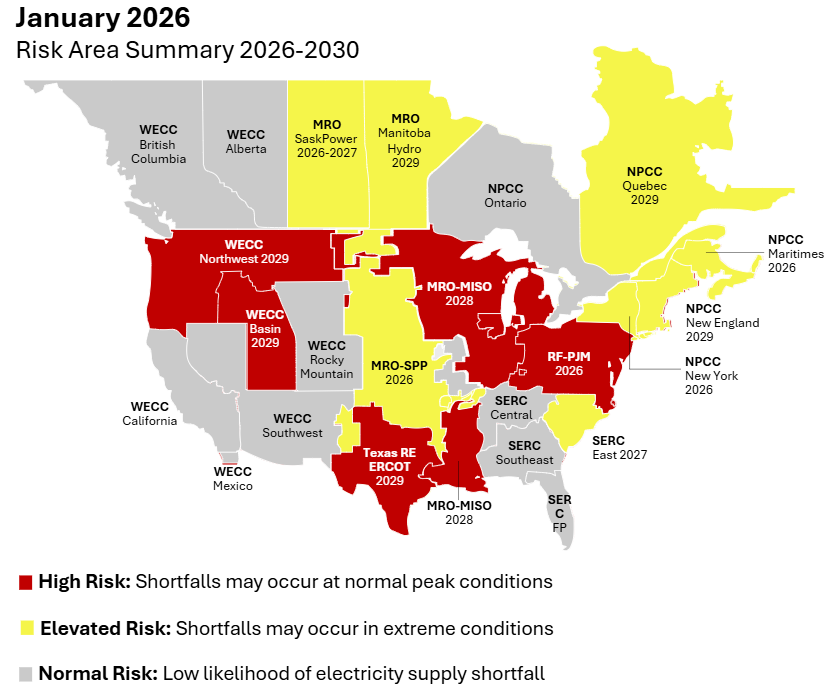
Source: January 2026 Long Term Reliability Assessment (NERC)
What do PJM capacity shortfalls mean for commercial & industrial facilities?
Capacity shortfalls mean outages. Brownouts or blackouts become more common during peak load hours. In extreme weather conditions, fewer resources are available to make up the difference when transmission lines get knocked out or a power plant goes offline.
For example, in March 2026, high winds and a Nebraska wildfire left 450,000 customers in Ohio, Pennsylvania, and Michigan without power.
The problem will likely grow. NERC estimates that the hours with loss of load (LOLH) will increase from 0.61 hours per year in 2027 to 9.97 hours per year in 2029.
For big retailers and manufacturers, power outages mean work stops. Machines can’t run, the lights go off, stores close, and infrastructure sits idle. This causes supply and distribution chain problems, curtails sales, and reduces revenue — while other costs, like overhead and wages, remain high.
Companies can calculate the cost of outages using Value of Lost Load (VoLL), a measure of how much a customer would pay to avoid an outage. VoLL varies depending on the cost of power and the nature of the industry, but ERCOT’s most recent study recommended a $35,000/MWh VoLL for power customers in the ERCOT exchange.
Using that figure, for a 25MW facility, five hours of annual power outages — the average for U.S. utility customers — would mean $4.4 million in VoLL.
How does poor grid quality affect manufacturing operations?
In addition to outages, power quality matters for manufacturers. When the grid is overstressed, the power supply is more likely to have voltage fluctuations or harmonics that cause manufacturing problems, affect reliability, slow production, or even damage equipment.
A foundational study by the Electric Power Research Institute found that the companies most vulnerable to power quality disturbances (like manufacturers) suffered average annual losses of more than $40,000 per business, or $60 billion total, with total costs for all U.S. businesses somewhere between $145 billion and $230 billion.
Why commercial customers are investing in their own power
Data center builders are increasingly planning to install their own onsite power generation. PJM itself is helping to accelerate this “Bring Your Own Power” (BYOP) trend, proposing a 10-month expedited interconnection and streamlined permitting for large loads with BYOP.
To retain cost-effective access to power, commercial and industrial leaders also need to look at BYOP, and install their own generation alongside grid power — or instead of it.
Onsite power, also referred to as decentralized or distributed power, means electricity generation happens directly at the location where it will be used rather than relying solely on the grid. It can work alongside grid power or operate independently in “islanded mode.” Common onsite power technologies include solar panels, small gas turbines, fuel cells, and diesel generators.
Onsite power is gaining popularity for numerous reasons, including fast lead times, reliable power, and stand-alone power capabilities.
Energy solutions for onsite reliability
Bringing your own generation doesn’t have to mean noisy, expensive, hard-to-maintain turbines or generators. And with a five to seven-year wait for new gas turbines to be installed, those technologies may not be any faster than waiting for the grid anyway.
Instead, many onsite power customers are turning to solid-oxide fuel cells, a proven, reliable electricity generation technology — and one that can be set up and providing power in months, not years.
Fuel cells are quiet and do not require continuous supplies of water, making them more locally appropriate than many other generation technologies. They run on natural gas, so they can take advantage of the same gas distribution network that is already widely available.
Which industry and retail leaders use fuel cells for onsite power?
Some of the world’s biggest power-intensive companies are already making the switch to BYOP powered by fuel cells.
A global semiconductor manufacturer based in the U.S. was looking to expand production in its New Jersey and Pennsylvania plants, but faced challenges securing reliable, cost-effective power. Bloom delivered 11.8 MW of advanced microgrid fuel cells across three of its sites.
Owens Corning partnered with Bloom to install two 200-kilowatt Bloom Energy Servers sized to provide approximately 65 percent of the plant’s power over the course of a year.
Quanta Computer used Bloom Energy to deploy a scalable, reliable onsite energy solution for its manufacturing facility in Fremont, California in 2024 — then it expanded the agreement by more than 150% within half a year.
Walmart has more than 40 Bloom installations at stores and distribution centers in California, providing up to 60-75% of the facilities’ electrical load.
These commercial and industrial customers have proven that onsite power can be clean, quiet, reliable, and quick to install. With capacity challenges and rising prices for grid power, now is the time to investigate BYOP alternatives.
Contact Bloom to learn more about our solutions for onsite power.