Key Takeaways:
- Fuel cells can support 200,000+ cycles
- Designed for continuous onsite power, Bloom Energy fuel cells offer 99.9-99.999% availability
- Fuel cells can achieve 90%+ efficiency
- Fuel cells are quiet, emitting <65 dB at 10 feet
- No water use is required for fuel cells in normal operation
- Fuel cells are the leader in onsite technologies (47% of developers are considering them)
- 109 MW of fuel cells can produce the same 99.9% availability as 130-150 MW of gas turbines
Traditional power infrastructure is struggling to keep up with data centers’ growing demand for electricity. The Electric Power Research Institute (EPRI) predicts that data centers could consume 9% to 17% of U.S. electricity by 2030, more than double their current use (4% to 5%).
At the same time, power availability has become a primary factor in data center site selection. Bloom Energy’s 2026 Data Center Power Report estimates that the U.S. IT load capacity could grow from approximately 80 GW in 2025 to 150 GW by 2028.
The challenge becomes not just finding enough electricity, but also securing it quickly, reliably, and at scale. As a result, developers are increasingly turning to onsite generation and fuel cells for data centers to produce reliable, always-on power without relying on the traditional electrical grid.
Fuel cells may just be the answer to data center power challenges.
Why Fuel Cells Are the Most-Evaluated Onsite Option for Data Centers
Onsite generation and fuel cells for data centers offer a solution to the many constraints of traditional power grids, which struggle to keep up with the growing demands of AI infrastructure.
Bloom Energy’s 2026 Data Center Power Report revealed that 73% of surveyed developers were actively exploring onsite generation technologies. Of them, fuel cells were the top contender, at 47%, followed by reciprocating engines at 38% and mobile turbines at 33%.
Developers recognize that fuel cells for data centers offer the following advantages:
- Shorter lead times that reduce time-to-power risk
- Lower local emissions, which help speed up permits and gain community support
- Scalability and modularity, including the ability to ramp output
- Alignment with long-term sustainability objectives, such as achieving 24/7 carbon-free energy compliance
According to the report, roughly one-third of data centers in 2030 will use 100% onsite power—a 22% increase from the previous findings. The report also revealed an emerging trend toward direct-current (DC) architectures, as 45% of respondents expect to implement them by 2028.
Even Goldman Sachs has recognized the importance of this growing trend. The leading global investment banking, securities, and investment firm estimates that fuel cells could be responsible for 8 to 20 GW, or 6% to 15%, of incremental data center power demand by 2030.
Spiky Loads Demand Instantaneous Response
One of the biggest challenges for data center power is that AI workloads have extreme variability in their power demands. A single server’s power load might fluctuate from 15kW to 30kW within seconds, scaling up to 50-100 MW swings at the data center level, according to Bloom Energy tests. In terms of capacity, that could mean going from 20% of provisioned power to 150% — and the traditional grid infrastructure can’t handle that kind of swing.
Data centers need power solutions that can match the “spikiness” of those loads. Many have been addressing this by adding batteries, but batteries have a limited number of charge-discharge cycles.
“Fuel cells and supercapacitors can easily handle this kind of load profile,” Bloom Energy’s Kaushal Biligiri said, noting that this combination can provide instantaneous responses to load changes, achieving 200,000+ charge cycles while maintaining 99.9% availability.
Can Fuel Cells Run 24/7 as Primary Power?
Yes, fuel cells can run continuously as a primary power source.
Unlike wind or solar, fuel cells do not depend on weather or time of day. Instead, they generate electricity through an electrochemical reaction. As long as fuel and oxygen are available, fuel cells can deliver 99.9% to 99.999% availability, depending on configuration and redundancy.
To see this in practice, we can turn to Intel’s Santa Clara data center. It’s been using Bloom’s fuel cells since 2014, and it’s currently operating at 1.06 PUE.
In the past, some have objected to fuel cells because they were not equipped for rapid on-off cycling associated with fluctuating power demands. However, with the addition of supecapacitors, fuel cells are very well suited to handle “spiky” power loads. It’s also important to note that fuel cells don’t manage rapidly fluctuating power loads through frequent startups and shutdowns of the fuel cells themselves. Instead, they’re a primary-power technology meant to run continuously on a 24/7 baseload.
Islands on the Rise
Grid interconnection delays are pushing data centers toward islanded microgrids. In these cases, fuel cells run completely off-grid in load-following mode.
“Every utility requires an interconnection agreement before it can accept a distributed energy resource onto its network. And that takes time,” said Biligiri. In the meantime, onsite fuel cells from Bloom Energy can operate as islanded microgrids. This means power generation is completely off-grid, with fuel cells sitting next to the data center generating power 24/7, load-following the data center’s needs.
After the data center operator reaches an interconnection agreement with the utility, this microgrid can be connected to the utility’s grid. Then the fuel cells can provide supplemental power to the grid, increasing reliability and capacity for the entire region.
These onsite systems can avoid delays and be deployed in just weeks on a skid-mounted, moveable platform, depending on local permits. They can also be deployed and relocated to meet changing power needs, while grid-connected systems support the local grid. This is crucial because the average wait to connect a new generation source to the grid is now five years.
In this way, fuel cells can act as a bridge, responding to both immediate power needs and longer-term grid infrastructure. This allows data center projects to continue to move forward while permanent grid connections are put in place.
Capturing Heat Drives Remarkable Efficiency
Efficiency becomes a pressing concern when power is costly and time-consuming to obtain.
Here, too, fuel cells have an advantage. Because solid oxide fuel cells (SOFCs) generate heat, it’s possible to capture that heat and use it. By combining heat and power applications, fuel cell efficiency rises from 54% to over 90%.
Exhaust heat above 350°C can be used to support absorption chilling. Biligiri said, “We can use fuel cells integrated with absorption chillers, generate chilled water and run it through the liquid cooling loop. That can drive a 10 to 15% improvement in the power usage effectiveness (PUE) value, which is an important sustainability metric for any data center.”
Get Modular and Get Going
As data centers follow utility pricing around the country (or around the globe), there’s an increasing demand for containerized, turnkey solutions to help those data centers get up and running quickly.
Biligiri noted that the modular nature of fuel cell units is a big selling point: They enable rapid installation of power generation capacity.
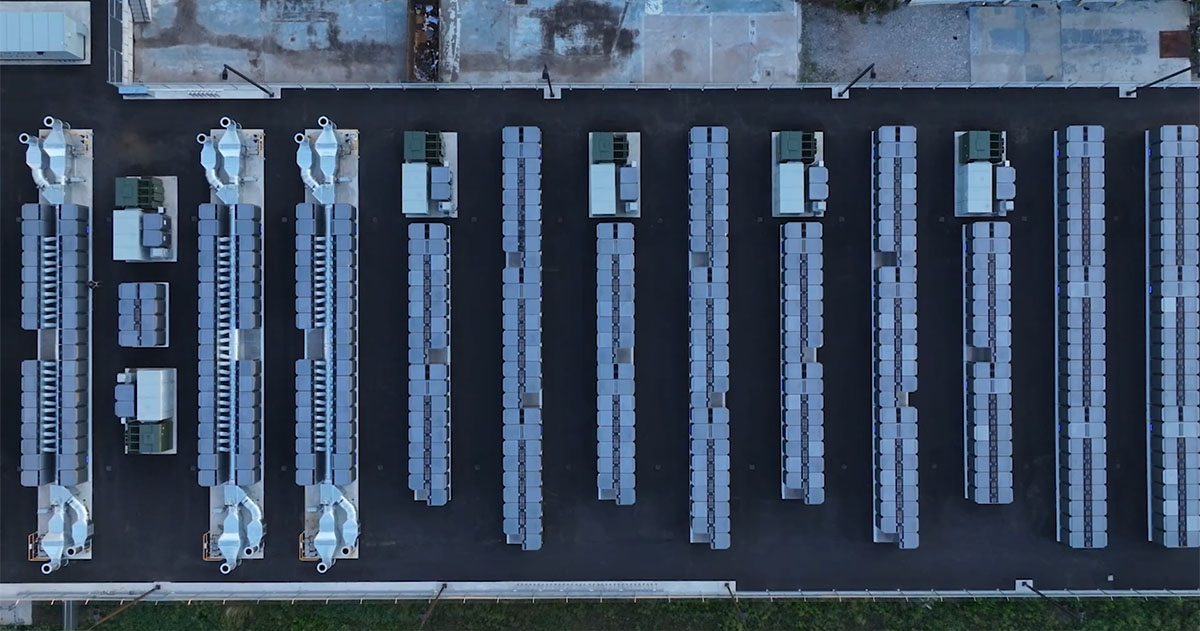
“Fuel cells arrive on site on a skid, and we just stack them on steel structures,” Biligiri said.
Bloom’s systems are purpose-built from 20 MW to 500 MW and the company can deliver 50 MW to 100 MW of fuel cell capacity in a few months. Bloom got Oracle’s fuel-cell system up and running within just 55 days. Their setups are scalable, too.
Because capacity is added in modular blocks, operators can pay for power as they grow rather than overbuilding on day one. Bloom Energy grew Equinix’s pilot program from 1 MW to 100 MW across 19 sites in six states.
That modularity gives developers the flexibility to grow as demand increases, while reducing the time and infrastructure needed to get a new data center up and running.
Urban-Friendly Solutions
As data centers grow, land use becomes a significant factor. This is especially important in urban or suburban locations, where real estate is at a premium.
Fuel cells offer high power density, can be stacked in layers and are extremely quiet, operating at 65 decibels from 10 feet away. “You can stand next to a fuel cell while it’s generating power and have a conversation without any noise issues,” said Biligiri.
There is almost no nitrogen oxide (NOX) pollution because the operating temperature of an SOFC is too low for the NOX reaction. There’s also no sulfur oxide pollution (SOX) because the sulfur-containing odorants have been filtered out before the natural gas reaches the fuel cell. And, with an enclosed system that has few moving parts, there are no volatile organic compounds (VOCs) emitted due to methane leaks.
Furthermore, the fuel cell’s electrochemical process recycles the water that the reaction generates, so it doesn’t require additional water for normal power generation. In fact, over a 15-year period, Project Jupter’s 2.8GW fuel cell system is expected to use about as much water as nine average U.S. households. To put that in context, 2.8GW could be enough to power almost 3 million U.S. households..
These characteristics make fuel cells well suited for densely populated areas where developers need to be especially mindful of noise, emissions, and water use.
Service Model and System Lifetime
When partnering with Bloom, there are several ways to structure a fuel-cell project, including power purchase agreements (PPAs) and Managed Services. You can enter into a PPA ranging from five to 20 years, or agree to Managed Services terms of six years.
Bloom also offers fuel cell replacements. In fact, over the last decade, the interval between fuel cell replacements has increased from just under two years to over five years, with the end of useful life defined as 45% fuel efficiency.
Bloom manages installation, operation, and remote monitoring.
Efficient, Reliable Onsite Energy — Today
Bloom has a robust portfolio of approximately 1.5 GW spread out across 1,200 installations. And the growth continues.
Oracle’s Project Jupiter data center will be supported by up to 2.45 GW of installed Bloom Energy fuel cell capacity, replacing the project’s previously planned gas turbines and diesel generators and consolidating the facility into a single microgrid campus. Compared to those planned turbines, Oracle projects the Bloom microgrid will reduce NOx emissions by approximately 92%.
Separately, Bloom and Oracle have a master services agreement supporting up to 2.8 GW, with an initial 1.2 GW contracted and deployment underway; the first fully operational system was delivered in 55 days, more than a month ahead of the 90-day schedule.
Other companies are following suit. AEP plans to use up to 1 GW of Bloom fuel cells, while Equinix has already surpassed 100 MW of fuel cell installations. Bloom is also partnering with Brookfield and CoreWeave, among others.
Frequently Asked Questions
- Are fuel cells a good power source for data centers?
Yes, fuel cells deliver continuous primary power with high availability. Fuel cells provide data centers with reliable, low-emission power that can be quickly deployed and easily scaled. This makes them an ideal solution for data centers with increasing energy demands and limited grid capacity. - Can fuel cells run 24/7 without stopping?
Yes, fuel cells are designed to operate continuously rather than to start and stop frequently. They deliver reliable power around the clock, helping them keep up with growing energy demands. - Can fuel cells power large data centers?
Yes, fuel cells are designed to power large data centers that require significant power. Many data centers are already using this technology to deliver primary or backup electricity without combustion. Because fuel cells are modular, they can be quickly deployed and scaled to meet the ever-changing needs of data centers. - How do fuel cells handle step loads?
Bloom Energy fuel cells respond to load increases at least twice as fast as rotating generators, and step down instantly. Paired with supercapacitors, the system reaches 100% response in milliseconds. That load-following capability is why fuel cells can serve volatile AI loads as primary power rather than only as steady baseload.