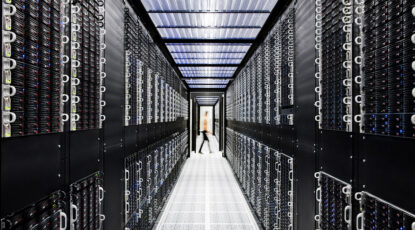

Data centers have become an integral part of the modern world. They are the backbone of the internet, ensuring that all our exchanges of information, money, and conversation happen in the blink of an eye. Without data centers, there would be no internet as we know it.
So keeping the power flowing to data centers is incredibly important. That has become markedly more difficult with the continued development of artificial intelligence (AI) models on top of modern society’s demands for more streaming, more information, more everything. These heavy tasks require more power from the data center, resulting in higher and fluctuating demands on the power grid that the data center draws from.
That, in turn, puts a heavy strain on the grid and everyone else using it. It also drives up the use of traditional fossil fuels needed for the grid to supply power. Higher expenses and bigger carbon footprints hurt everyone. What can be done?
Enter the data center microgrid.
What Is a Microgrid?
A microgrid is, at its core, a self-contained grid that a data center can draw power from. In some cases, it can connect to a larger regional electrical grid, but in others, it stands alone.
Microgrids are not a particularly new concept; we actually have Thomas Edison to thank for building what is essentially a microgrid at Pearl Street Station in 1882. Since then, microgrids have operated on traditional fossil fuels and have been primarily used as backup power sources in the event of a grid outage. In more recent decades, they’ve been used by college campuses and communities in areas that may not always have a steady connection to a grid due to isolation or inclement weather.
As of 2025, the microgrid has emerged as a solution to surging energy demands of all sorts, but particularly for data centers. Not only can they keep a data center running via on-site power generation, but they can also significantly reduce a data center’s environmental impact by providing a cleaner electricity source.
How Microgrids Boost Data Center Resilience
The beauty of microgrids is that they can generate, store, and distribute power entirely on their own. Many of them operate independently at all times or can disconnect from the main grid at will. So, how do microgrids increase resilience for data centers? If there’s an outage or disruption at the main power grid, the data center will remain unaffected.
These disruptions are happening more frequently. Extreme weather has done a number on the country’s critical infrastructure over the last few years; in 2020 alone, there were 22 individual weather and climate disaster events, each costing upwards of $1 billion in damages. Even when severe damage is avoided, Public Safety Power Shutoffs (PSPS) can disrupt energy delivery for hours or days.
And then there is the unfortunate reality of the increased cost associated with data centers — along with efforts to upgrade or harden them — that are passed on to customers. This has led to numerous communities pushing back against the building of proposed data centers.
With that context, the microgrid emerges as a localized power source. Since it’s onsite and can provide electricity independently, it frees data centers from the volatility associated with power grids. Many microgrids store extra electricity in on-site batteries, ensuring the data center will have power even if something happens to the microgrid itself.
This energy independence is good for those who rely on the regular grid, too. With the data center removed from the main grid, high electrical costs should begin to drop.
How Microgrids Reduce Emissions
Most power grids rely on traditional fossil fuels to generate electricity, which emit pollutants and greenhouse gases into the atmosphere. Until the last few decades, this meant that data center managers had to store extra fuel or be prepared to purchase backup power, which was also typically generated by fossil fuels.
Modern microgrids are adopting a more eco-friendly approach to both generating power and taking the pressure off the main grid. They harness renewable energy sources to provide sustainable power by drawing energy from onsite renewable sources, including:
- Solar: Solar-powered microgrids convert sunlight into electricity. They’re quiet and can be powerful, particularly in areas that receive a great deal of sunshine, but their generation abilities are entirely dependent on the weather.
- Wind: Wind-powered microgrids, while also sustainable, have two major limitations: they’re dependent on the climate, and the wind-powered turbines need a lot of space.
- Combined heat & power (CHP): Also called cogeneration, CHP recycles captured waste heat and puts it back to work in other areas of the system.
- Fuel cells: Fuel cell microgrids are powered by natural gas or hydrogen, but they do not use combustion; instead, they generate electricity through electrochemical reactions. Bloom Energy’s solid oxide fuel cells provide clean, resilient energy for data centers.
- Biogas: This energy source is generated by the decomposition of organic matter, such as agricultural waste. The process captures methane, a greenhouse gas, and converts it into renewable energy.
Smart Controls = More Efficiency
The heart of the microgrid is its control system. Often referred to as “smart” control, this powerful software monitors all activity within a data center. Generators, inverters, and batteries are all monitored by the control system, which also constantly determines where to draw power from.
It is constantly — moment by moment — deciding whether it should pull from onsite power or the traditional grid. If a microgrid has multiple sources available, it will also monitor those sources and determine the best mixture of them at any given time. If a microgrid has solar panels and it’s a sunny day, the smart control might opt to run on solar for a few minutes or even all day, if the weather conditions are optimal. That night, it could top off its batteries with stored power pulled from the grid.
Smart controls also track mission-critical systems in a data center. If there is an outage or limited power availability, they can dedicate power to essential IT systems while scaling back in other areas like non-urgent processing jobs. All of these decisions are made second by second, far faster than a human brain could hope to process.
The smart control system makes a microgrid its own intelligent ecosystem. Because it makes snap decisions based on efficiency, it significantly eases the strain a data center can place on a traditional grid. The data center, in turn, can run smoothly and often with significant cost savings for its operator.
The Future of Microgrid Resilience Is Bright
Data centers that incorporate microgrids into their operations are managing energy demands while shaping a more sustainable future. While data center microgrids do require an initial investment, the cleaner, renewable energy they provide brings new levels of resilience to data centers and other structures that rely on them.
Ready to learn more about how Bloom Energy’s microgrids can reduce your dependence on traditional grids and guard your data centers from outages and disruptions? Contact us today.